
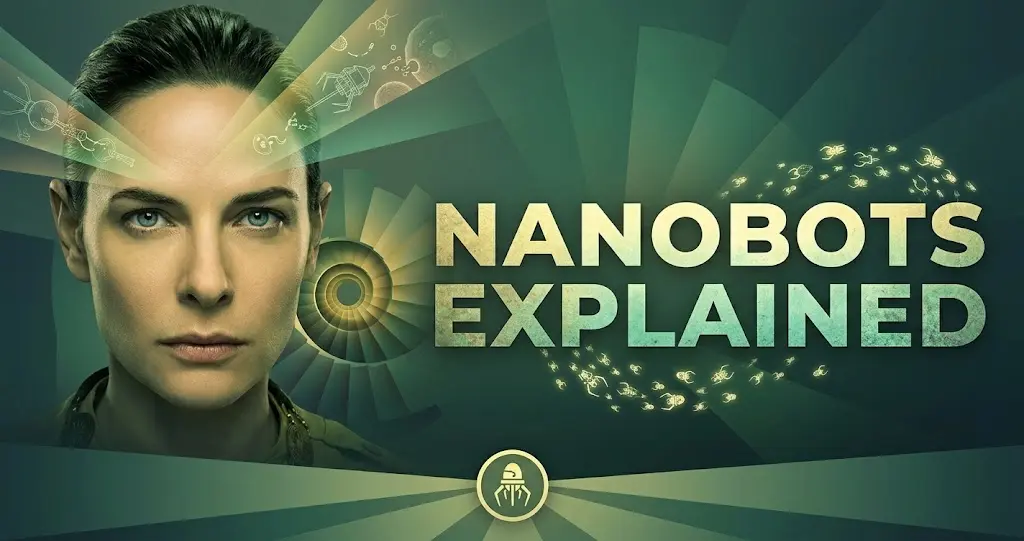
In brief:
The nanos in Silo are microscopic, self-replicating machines developed as weapons. They can affect both people and technology, and their full connection to the silos is one of the series’ developing mysteries.
Spoiler warning!
This post contains major spoilers for the television series and Hugh Howey’s books.
Nanobots in the series so far
What are the nanobots?
Nanobots, or “nanos”, are microscopic machines built at the nanometer scale. In Season 3, Episode 1, “Who Are You?”, Charlotte encounters them as a black-grey cloud that disables her aircraft; the substance later appears on her hand as an oily, threadlike goo. Episode 8, “Gray Goo”, confirms that these self-replicating machines are nanoweapons. Per Stensen cites weaponized nanotechnology as one of several existential threats that led him to build the silos. More can be speculated about their role but not without giving away book spoilers. (More later)
Where did they come from?
The series identifies an Iranian facility as the source of the nanoweapons encountered by Charlotte’s squadron. Per Stensen and Senator Thurman explain that the United States had already been tracking Iran’s military nanotechnology program before authorizing the mission. Per Stensen also made his fortune from nano technology.
Update September 8, 2026
Episode 10 in Season 3 was very revealing. We saw Troy (Daniel) reviving from cryo-sleep, covered in the gray goo—or ‘good’ nanos. We also learned that a toxic compound was dropped on the people of Silo 17 by order of Troy, which may have been ‘bad’ nanos. Also in Episode 9, we saw Bernard covered in a gray mist in the airlock as he exited without a suit, so it seems that cleaners are coated in bad nanos before they even set foot outside. The nanos eat through the bad tape and are lethal to the cleaners, which gives the people inside the impression that it is not safe outside, even in a suit.
Where have they been used?
Iran remotely deployed a nanoweapon in the Dulles Technology Corridor. Authorities publicly described the incident as a dirty-bomb attack, concealing its true nature. The United States later sent Charlotte’s squadron on a mission that ultimately served as bait for Iran’s defensive nanoweapon cloud. After the aircraft were disabled, the United States destroyed the Iranian facility using nuclear weapons fired through a tunnel from Turkmenistan.
Speculation for the series
Because I have read the books, it is difficult to speculate without revealing major plot points. If you plan to read the trilogy and want to avoid book spoilers, skip ahead to My thoughts or keep reading for spoilers.
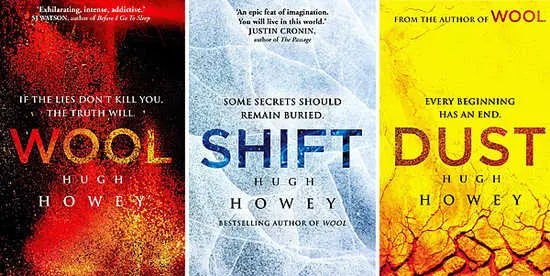
Book-based speculation
Shift and Dust reveal that two kinds of nanos exist: harmful nanos that attack people and beneficial nanos that heal damage and protect treated people from the effects of the harmful nanos. The television series retains much of the books’ framework, but its new characters and altered plotlines leave room for different explanations.
Shift also reveals that the people overseeing the silo project were placed in cryogenic pods inside Silo 1. They were awakened in shifts to monitor the silos, then returned to sleep; the pods also delivered repeated doses of beneficial nanos. One of those overseers is Donald Keene, who is Daniel Keene in the series. Confirmed S3E10.
The books confirm that hostile nanos create a “dome of death” around the silos, while nature thrives beyond it. The series has not yet confirmed that explanation. Refuted S3E10. (The people who made it outside from Silo 17 would have survived if Silo 1 did not use drones to deploy a compound and finish off the rest with bullets).
One remaining possibility is that the Safeguard does not release an ordinary poison at all, but a weaponized cloud of nanos capable of killing an entire silo.
The books offer a possible explanation for Silo 17 as well. Hugh Howey has said that Silo 17 received a massive dose of beneficial nanos, which allowed survivors such as Solo to live and later helped protect people passing through it. The series could adapt that idea directly, or use it as the basis for a new explanation of why some residents survived the Safeguard.
Why the nanos matter to the silos
Nanos could connect several of the story’s biggest mysteries. In the books, hostile nanos explain why the world immediately around the silos remains lethal, while beneficial nanos explain how selected people recover from injuries or survive exposure that should kill them. That makes the technology more than background lore: it is part of the control system that keeps residents underground, allows a silo to be destroyed, and determines who may survive long enough to rebuild. Hugh Howey’s explanation that the original silo residents received beneficial nanos—and that Silo 17 later received a massive dose—shows how the same technology can both enforce the project and preserve its intended survivors.
How the nanos appear to work
The nanos behave less like a conventional gas and more like programmable, self-replicating machines. Harmful nanos can attack living tissue, while beneficial nanos perform maintenance and repair inside the body. They can apparently be delivered in controlled doses: Howey says the original silo population already carried beneficial nanos, received further treatment during cryogenic sleep, and could be exposed again through places such as Silo 17. The series has shown a visible grey swarm disabling aircraft, suggesting that nanos can damage machinery as well as people. However, although the series has revealed destructive nanos, it has not yet revealed the beneficial healing nanos from the books. Juliette’s and Charlotte’s persistent scars may even suggest that neither has been exposed to them, or at least not enough of them to complete their healing. What remains uncertain is how the nanos are directed, how long they remain active, and whether the Safeguard uses the same type as the hostile nanos surrounding the silos. Update S3E10 Charlotte’s scars are gone but Daniels still has a large scar on one hand.
What Howey said about them in a Q&A
In his Q&A “Massive Spoilers!”, Hugh Howey explains that everyone in the original silos carried beneficial nanos; those machines were why they survived the event that killed the wider population. People placed in cryogenic sleep received further treatments each time they entered the pods. The nanos could repair damage from exposure to the outside air, but their protection was not unlimited: Donald Keene, the book character introduced above, deteriorated after leaving treatment early and missing later doses. Howey also says Silo 17 received a massive infusion of beneficial nanos from Silo 1, with help from Silo 40. That dose explains Solo’s survival, Juliette’s healing, and how the people from Silo 18 may have survived their later journey across the surface.
In brief:
Confirmed in the series: Nanos are self-replicating microscopic weapons that can form a grey cloud and disable aircraft. Good nanos are administered to people in cyro-sleep.
Confirmed in the books: Harmful nanos create a lethal zone around the silos, while beneficial nanos heal damage and protect treated people from their effects.
Speculation: The series may connect nanos to the Safeguard, and some otherwise surprising survivals, but it has not yet confirmed those connections.
My thoughts
As a writer, what I love the most is the way Hugh Howey builds a strange environment that constantly makes the reader ask, “Why?” Why are the silos designed this way? Why is the outside still lethal? Why do some people survive when others do not? The nanos eventually connect many of those mysteries, turning details that once seemed arbitrary into parts of a larger system. That is something I also wanted to achieve in my novella, Dream Job: Book 1: to place people in an unusual environment where every answer creates another question.
As far as the real world goes, I do not entirely buy the nanos themselves. Sure, the technology of the future will blow our minds, but I find it difficult to imagine tiny machines that are as powerful as today’s data centers, reading our DNA and killing people with the wrong DNA. Or that they could be so widely networked, so precisely controlled, and remain effective across centuries. They sometimes feel less like a plausible technology than an all-purpose mechanism the story can call upon whenever it needs one.
But let’s cut Howey some slack. Wool began as a standalone short story that only involved the mysterious deaths of Sheriff Holston and his wife, Allison. It left readers craving more, so its world and explanations grew alongside its audience until it became three standard-sized novels. The nanos are a futuristic threat and they provide a hidden logic for the world. Their real value is structural: they allow separate mysteries to converge without taking away the unsettling sense that the characters live inside a system they only partly understand. I nitpick, but I tip my hat at the same time, and none of my stories would survive the same level of scrutiny that Silo gets. Sometimes you have to just enjoy the ride.
Related
In Plot Analysis for the Silo Universe Stories in ‘Machine Learning‘ I give my thoughts on a series of short stories that extend beyond the initial triogy.
In Are Nanobots Real? Silo Science Explained I go into more detail about why the nanobots of Silo will probably always be out of reach but list some very impressive real world examples of nanotechnology.
Sources Used
- Silo on Apple TV — the television series, including the episodes discussed in this post.
- Wool, Shift, and Dust by Hugh Howey — the original Silo trilogy and the main source for the nanobot lore.
- “Massive Spoilers!” by Hugh Howey — the author’s detailed Q&A about the trilogy, including the roles of the “good” and harmful nanobots.
Got Questions?

2 responses to “The Nanobots of Silo, Explained”
[…] The Nanobots of Silo, Explained […]
[…] In The Nanobots of Silo, Explained I discuss the origin and roll of nanobots in the Silo universe. […]